Six posts, six studies, and the gap in between
We pulled the research behind six viral posts from Aubree Adams and the organizations she directs. Almost all of them cite real, peer-reviewed studies. The problem is what happens between the paper and the graphic.
A recurring pattern runs through the graphics published by Aubree Adams and the organizations she directs, Every Brain Matters and Citizens for a Safe and Healthy Texas. The studies they cite are, for the most part, real and legitimate. What changes is the framing: a rate that applies to a narrow clinical group gets presented as if it applies to everyone, an association gets relabeled as a cause, or a rare harm in heavy users gets generalized to all use. We took six posts and read the underlying papers. Here is each claim against what its study actually says.
1. “About 28% of the trippers” become chronically psychotic
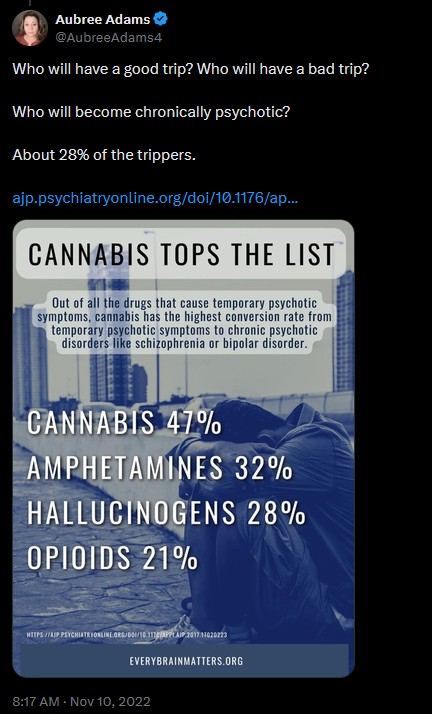
The post (Adams, Nov 2022) asks “Who will become chronically psychotic?” and answers “About 28% of the trippers,” over a graphic reading “Cannabis tops the list” with cannabis at 47%, amphetamines 32%, hallucinogens 28%, opioids 21%.
The study is a 2017 Danish registry analysis in the American Journal of Psychiatry (Hjorthøj and colleagues). Its finding: among people who had already experienced a substance-induced psychosis, 47% of those whose psychosis was cannabis-induced later converted to schizophrenia or bipolar disorder, the highest rate of any substance.
The gap. That 47% is not the share of cannabis users, or even of “trippers,” who become psychotic. It is the conversion rate among people who were already hospitalized or diagnosed with a drug-induced psychotic episode, a small and already high-risk group. Adams’s caption takes a number that is conditional on an existing psychosis diagnosis and reframes it as the fate of recreational users. It also mislabels the figure: 28% was the hallucinogen number in the graphic; cannabis was 47%. The study’s own claim (“highest conversion rate”) is accurate within its population. The caption’s claim about “trippers” is not.
2. Teen cannabis use “doubles” serious mental health risks
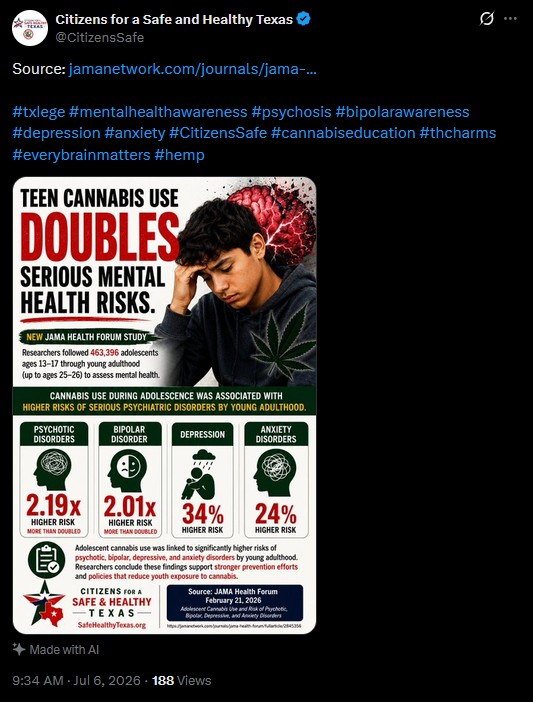
The post (Citizens for a Safe and Healthy Texas) headlines “Teen cannabis use doubles serious mental health risks,” with 2.19x psychotic disorders, 2.01x bipolar, 34% higher depression, 24% higher anxiety, from a study of 463,396 adolescents.
The study is real and large: Young-Wolff and colleagues, JAMA Health Forum, February 2026, an NIH-funded cohort of 463,396 Kaiser Permanente adolescents. It found those associations, and noted cannabis use preceded diagnoses by roughly 1.7 to 2.3 years.
The gap. This is the most accurate graphic in the set, and the fine print correctly says “associated with.” Two caveats the headline drops. First, it is an observational association, not proof of cause; the authors point to timing as suggestive, but reverse causation and shared vulnerability (early symptoms leading to self-medication) cannot be ruled out. Second, the absolute numbers matter: roughly 4,000 of the 463,396 teens developed a psychotic disorder, under 1%. Doubling a base rate near 1% still leaves a small absolute risk, which “doubles” obscures. Credit where due: the study is legitimate and the figures are close to faithful.
3. “Cannabis/hemp can be deadly”
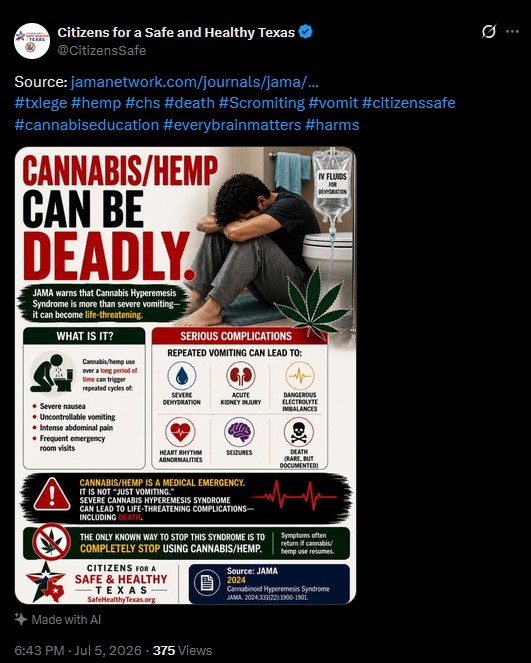
The post (Citizens for a Safe and Healthy Texas) declares “Cannabis/hemp can be deadly,” citing cannabinoid hyperemesis syndrome (CHS) and a 2024 JAMA source.
The source is a JAMA Patient Page from October 2024, a one-page patient-education handout describing CHS as a syndrome tied to frequent, long-term cannabis use.
The gap. CHS is real, and severe cases can lead to dangerous dehydration; fatal cases exist but appear in the literature as rare case reports, and the condition resolves when use stops. The graphic takes a rare syndrome in heavy, chronic users and generalizes it to “cannabis/hemp can be deadly.” It also presents a patient-education handout as though it were a warning study (“JAMA warns”), and folds in hemp, which the source does not single out. The syndrome and its complications are real. The sweeping lethality claim is not what the cited page supports.
4. “THC increases the risk of suicide”
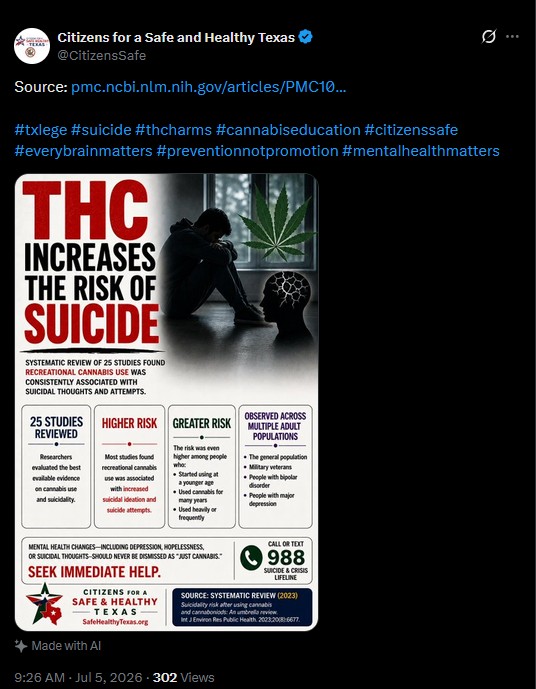
The post (Citizens for a Safe and Healthy Texas) reads “THC increases the risk of suicide,” citing a 2023 systematic review of 25 studies finding recreational cannabis “consistently associated with suicidal thoughts and attempts.”
The study is an umbrella review by Shamabadi and colleagues (2023), which found cannabis use associated with suicidal ideation and attempts across several populations. Evidence for an actual causal relationship was noted in only one included study, and it was described as bidirectional.
The gap. The headline asserts causation (“increases the risk”); the review found association, which the fine print correctly uses. The distinction is not pedantic here: people experiencing depression and suicidality are more likely to use cannabis, so the arrow can run the other way, and the review itself notes symptoms may mediate the link. A separate umbrella review in The BMJ rated even heavy-use-to-suicide-attempt as only “suggestive” evidence. (The graphic also cites a journal and page number that do not match this review, worth confirming.)
5. Cannabis and depression: “a clear link”
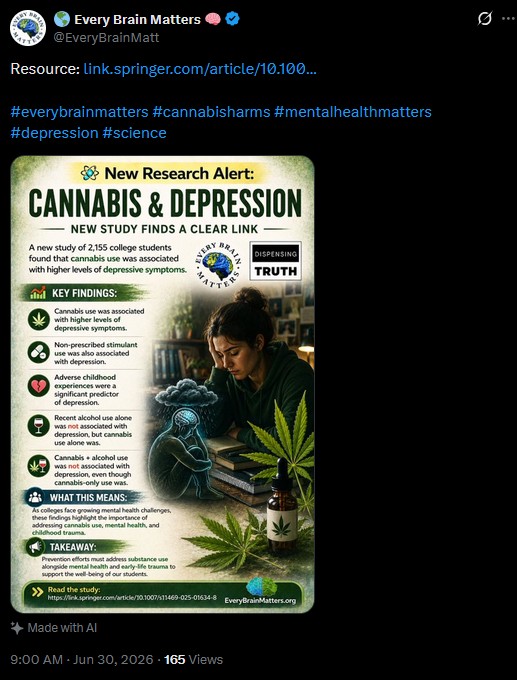
The post (Every Brain Matters) announces “Cannabis & depression: new study finds a clear link,” from a study of 2,155 college students.
The study is Bajracharya, Montemayor, and colleagues (2026, International Journal of Mental Health and Addiction). It is cross-sectional, self-reported, and drawn from an online panel. Cannabis use was associated with a roughly one-point increase on a 27-point depression scale, an effect the authors themselves describe as a small shift. Adverse childhood experiences were the strongest correlate; alcohol use alone was not associated.
The gap. The paper states plainly that its cross-sectional design precludes causal inferences, and raises self-medication as a live possibility. “A clear link” oversells a modest, one-point association from a design that cannot establish direction or cause. To its credit, the graphic reports the specifics fairly, including that alcohol alone was not associated, but the headline and the causal implication go past what the study can carry.
6. “Not legalizing marijuana is the best harm reduction”
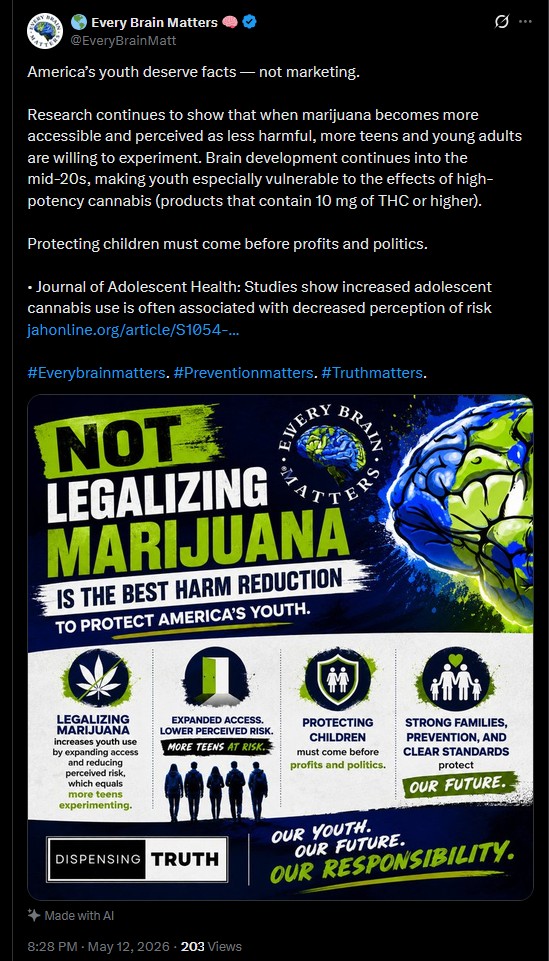
The post (Every Brain Matters) states “Not legalizing marijuana is the best harm reduction,” citing the Journal of Adolescent Health for the point that increased adolescent cannabis use is often associated with decreased perception of risk.
The gap. The cited fact, that lower perceived risk tracks with higher use, is well established and accurate. But it does not establish the headline. Whether prohibition is “the best harm reduction” is a contested policy conclusion, not a research finding, and the citation supports only the narrow perception-and-use correlation beneath it. The graphic attaches a policy slogan to a citation that does not reach it. (“Harm reduction” also normally refers to reducing harm to people who use a substance; using it to mean prohibition inverts the usual meaning.)
The pattern
None of this requires claiming the underlying science is fake. It is mostly real. The distortions are specific and repeat: a rate conditional on an existing diagnosis is presented as a general one; association is relabeled as causation; a rare harm in heavy users is generalized to all use; absolute base rates are dropped so a small risk reads as a large one; and a policy opinion is dressed as a research finding. The studies are not the problem. The distance between the study and the graphic is.
Sources
- Hjorthøj C, et al. Conversion to schizophrenia or bipolar disorder following substance-induced psychosis. American Journal of Psychiatry, 2017.
- Young-Wolff KC, et al. Adolescent cannabis use and risk of psychotic, bipolar, depressive, and anxiety disorders. JAMA Health Forum, 2026;7(2):e256839.
- Cannabinoid Hyperemesis Syndrome. JAMA Patient Page, 2024.
- Shamabadi A, et al. Suicidality risk after using cannabis and cannabinoids: an umbrella review, 2023; and Solmi M, et al. The BMJ, 2023 (evidence-tier umbrella review).
- Bajracharya S, Montemayor BN, et al. Early adversity, polysubstance use, and depressive symptoms in college students. International Journal of Mental Health and Addiction, 2026.
- Journal of Adolescent Health (adolescent risk perception and use).